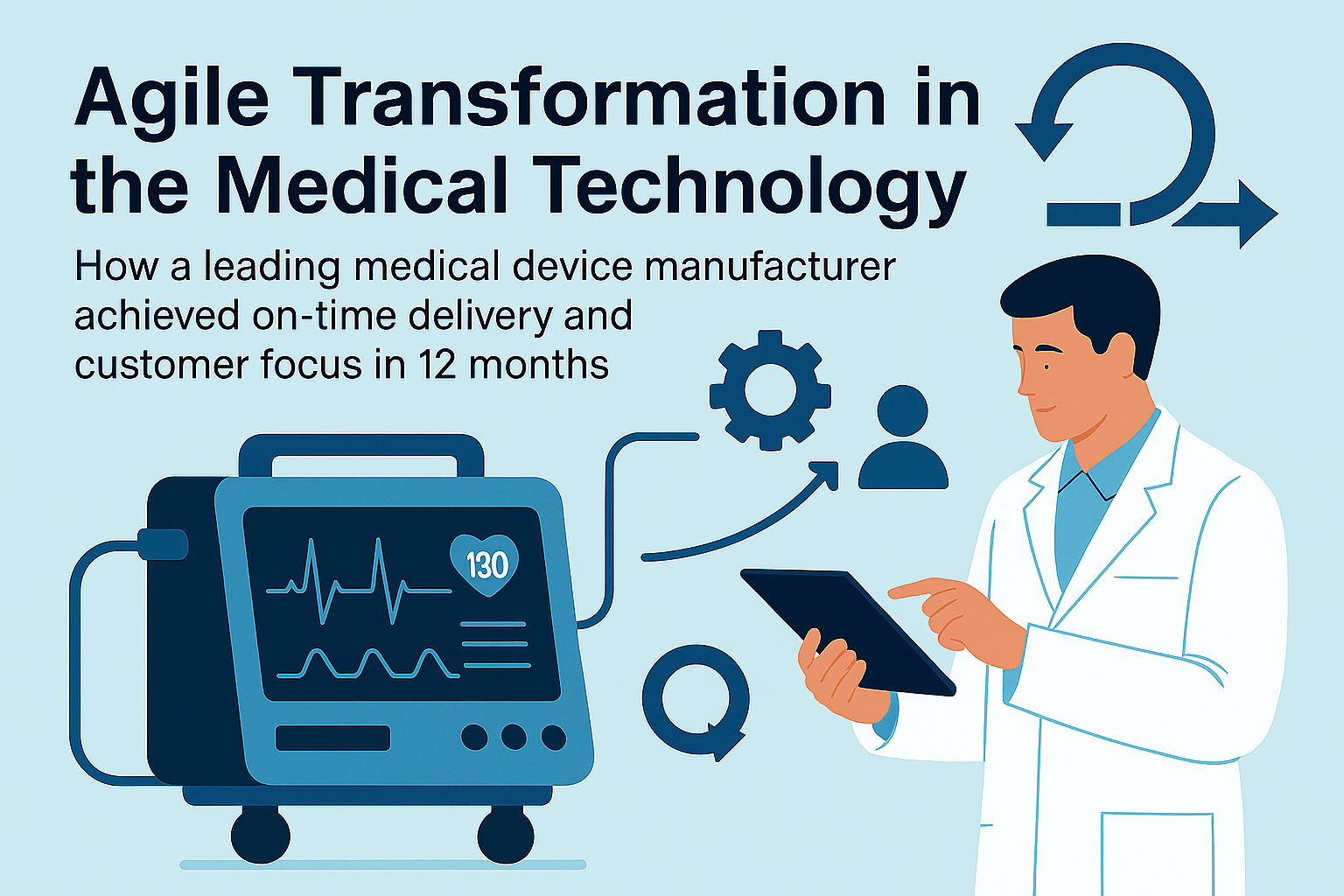
If agile transformation is to be more than just a buzzword, it needs more than templates and frameworks. It needs trust, genuine teams, and the courage to question habits. This was precisely the challenge facing a leading global manufacturer of medical devices, which wanted to become more agile, predictable, and customer-focused in its advanced therapies department. new direction GmbH accompanied the change over 12 months – from engineer-driven work to an agile organization with clear prioritization, realistic planning, and active responsibility.
The initial situation was typical for many technology-driven organizations: technical expertise was high, but teamwork was hampering delivery capabilities. Estimates were often too optimistic, leading to chronic planning uncertainty and straining trust between stakeholders and development teams. In addition, there were different stages of development at several test facilities, which regularly caused the integration of individual functions to stall.
Requirements were also not always clearly defined—many user stories were implemented but turned out to be incomplete during integration. Dependencies between subsystems were hardly visible in the project management tool, so teams often noticed too late that functions did not fit together.
Added to this was a classic challenge for engineering-driven organizations: the focus was on technical excellence, not end-to-end customer value. Silo thinking and a large number of “single sources” created critical dependencies. The culture was characterized by proven routines, but not always by transparency and commitment. Agreements were not consistently adhered to, and working from home meant that the culture of rapid coordination noticeably lost momentum.
The question was not: Do we master our technology? – but rather: How do we shape our strengths in a way that truly has an impact – for the customer, the product, and the overall system?
The transformation was deliberately not started abruptly, but step by step – with an approach that focused on trust, clarity, and responsibility. SAFe and Lean principles were introduced pragmatically and adapted to the needs of the organization.
The decisive progress came about through the establishment of an open communication culture. Retrospectives were not seen as a ritual, but as a space for real problems – without blame. Psychological safety became a prerequisite for honest estimates and realistic commitments. Leadership coaching created a new understanding of roles: leadership is not about control, but about enabling.
SAFe was not introduced “by the book,” but interpreted in line with the organization's needs. Key principles were applied in a targeted manner: visualization of dependencies, WIP limits to control flow, clearly structured PI planning, and a consistent economic approach to decision-making. Systems thinking helped the teams to focus on the big picture again – not just on optimizing individual components.
Step by step, teams were set up so that they could develop features holistically – in an interdisciplinary manner and with clear responsibilities. Definition of Ready and Definition of Done ensured that work was only started when all framework conditions were clear – and that it was also reliably completed. Unpleasant tasks were no longer postponed, but continuously worked on in smaller steps. This significantly reduced the amount of rework.
After twelve months, a clear change was evident – both measurable and culturally noticeable. Planning accuracy improved significantly, adherence to deadlines became reliable, and the interaction between development and integration stabilized sustainably. Teams began to think in terms of systems and make decisions in the context of overall benefit.
However, the greatest success was cultural in nature: silo thinking gave way to collaboration. Optimism became realism. Technical excellence became customer focus. Agile principles were not introduced – they were understood and lived.
This change shows that transformation is not achieved through frameworks, but through people who take responsibility – and through an organization that gives them the space to do so.
At new direction GmbH, we implement such and similar solutions quickly and reliably. If you have any questions or specific concerns, please feel free to contact us directly.
Do you want to prepare your company for the digital transformation?
Then make an appointment with us now for a free consultation.